

Introduction
A tree emergency hits fast, and it almost always happens at the worst possible time. One moment you’re riding out a Central Florida storm, and the next you’re staring at a massive live oak through your living room ceiling. Emergency tree removal is not something most homeowners have dealt with before, and knowing what to expect can make a genuinely frightening situation feel a lot more manageable.
Is This Actually a Tree Emergency? What Can Wait and What Can’t
The short answer: if the tree or limb poses an immediate threat to people or structures, it’s an emergency. Not every tree situation needs a midnight phone call. But some absolutely do.
A tree that has fallen onto your home, garage, or vehicle is a true emergency. So is a large limb hanging over an occupied area, often called a “widow maker” by arborists, because it can drop without warning. A tree blocking a road or driveway after a storm also qualifies, especially if it’s cutting off access to your property or a neighbor’s. These situations need immediate attention because the risk of injury or additional structural damage grows the longer they sit.
On the other hand, a stump in your yard isn’t going anywhere dangerous. A dead tree that isn’t leaning over your house or a fence line can usually be scheduled as a routine removal. The key question to ask yourself is this: if this tree or limb moves or falls in the next 24 hours, does it hit something or someone? If the answer is yes, call a tree service now.
What to Do While You Wait for the Crew
Stay away from the tree. That’s the most important thing you can do while waiting for help to arrive.
Don’t try to cut the tree yourself, even if you have a chainsaw in the garage. Trees that have fallen onto structures or are hanging at odd angles are under enormous tension. Cutting into the wrong spot can cause the tree to shift suddenly and violently. Professional arborists train specifically to read that tension and cut in the right sequence. An untrained cut can turn a bad situation into a dangerous one in seconds.
While you’re waiting, document everything you can. Take photos and video of the tree, the damage to your home or property, and any debris. Do this from a safe distance. Then call your homeowner’s insurance company to report the damage. According to NOAA’s National Centers for Environmental Information, severe weather events cause billions of dollars in property damage across the United States each year, and Florida consistently ranks among the most affected states. Getting your claim started early matters. You can check current storm reports and weather event data through the NOAA storm data portal at weather.gov to support your insurance documentation.
The First Call: What Information to Have Ready
When you call for emergency tree service, having a few key details ready will help the crew respond faster and come prepared with the right equipment.
Give the dispatcher your exact address and a clear description of what happened. Is the tree on your roof? Is it blocking your driveway? Are there large limbs hanging over a porch or patio? Tell them whether anyone has been injured, whether power lines are involved, and whether the tree has penetrated the structure or is just resting on it. Power line involvement is especially important because it changes the response entirely and may require coordination with the utility company before any work can begin.
Be honest about the size of the tree if you can estimate it. A 30-foot water oak is a very different job from an 80-foot laurel oak, and the equipment needed is different too. The more information you can give on that first call, the faster the crew can mobilize with what they need.
What Happens When the Crew Arrives
The first thing a professional tree crew does is assess safety, not start cutting. They’ll walk the scene before touching anything.
The crew will look at how the tree is loaded, meaning where the weight is sitting and how the tension is distributed. They’ll check for secondary hazards like broken limbs still in the canopy, unstable root systems, or compromised structure underneath the tree. They’ll also establish a work zone and ask you and anyone else on the property to move to a safe distance. This isn’t just protocol. It’s how serious professionals operate, and it protects everyone on site.
After the assessment, the lead arborist will walk you through the plan. You’ll know what equipment they’re using, what sequence they’re working in, and roughly how long the job will take. Communication matters here. A good crew keeps the homeowner informed so there are no surprises.
The Removal Process: Step by Step
For a tree that has fallen onto a structure, the removal process is methodical and careful, not just a matter of cutting the trunk in half.
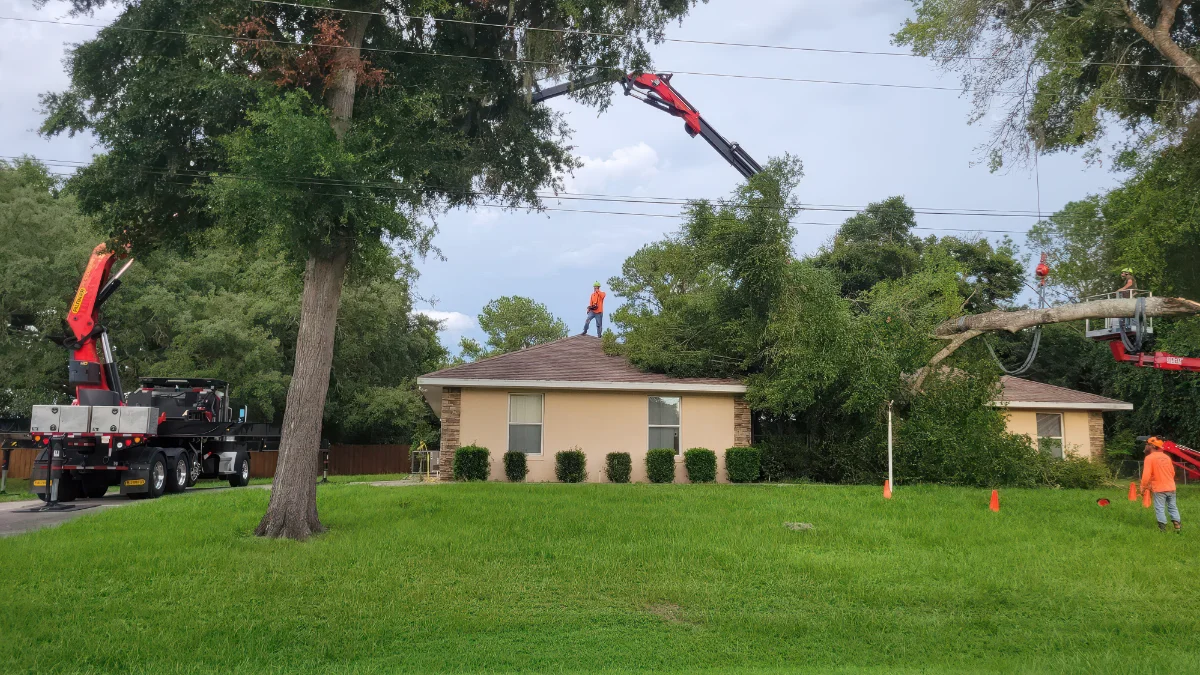
The crew will typically work from the top down, removing sections of the tree piece by piece using a technique called sectional removal. Rigging systems, which use ropes and pulleys, allow workers to control exactly where each piece falls so it doesn’t cause additional damage to your roof or walls. For large trees or situations where traditional climbing isn’t safe, specialized equipment like a remote control crane or grapple saw truck becomes essential. These machines allow crews to lift heavy sections away from the structure precisely, without anyone having to work directly above a compromised area. The Airborne Tree Service emergency storm response team uses this type of equipment regularly for exactly these scenarios.
Once the major sections are removed, the crew will cut and clear the remaining debris. Most professional crews will leave the site clean, hauling away the wood and brush as part of the job. Ask about this when you call so you know what’s included. For a single tree on a structure, the full process typically takes two to four hours. Larger or more complex jobs can take a full day.
Equipment That Makes a Difference in Emergencies
Standard tree removal equipment works fine for routine jobs. But emergency removals, especially after a Central Florida hurricane or microburst, often involve situations where standard methods aren’t safe or even possible.
Remote control crane technology allows an operator to position and lift tree sections with precision from a safe distance. This is critical when a tree has landed on a roof and the structure underneath is unstable. A grapple saw truck can grab and cut large sections simultaneously, which speeds up the process and reduces the number of people who need to be in the danger zone. These aren’t tools every tree company carries. They represent a significant investment that only operations with serious capabilities maintain.
Central Florida’s storm season runs from June through November, and the region averages more than 80 thunderstorm days per year. Afternoon microbursts in Marion County and the Ocala area can knock down trees with almost no warning. The Villages and surrounding Sumter County communities see the same pattern every summer. That frequency is exactly why having access to the right equipment matters when you need dangerous tree removal services in Central Florida.
Insurance and Emergency Tree Removal: What You Need to Know
Homeowner’s insurance coverage for tree damage depends heavily on what the tree landed on.
In most standard policies, if a tree falls and damages your home, garage, fence, or another covered structure, the damage to that structure is covered under your dwelling or other structures coverage. The cost of removing the tree from the structure is often covered as well, up to a limit. But if a tree falls in your yard and doesn’t hit anything, most policies won’t cover removal because there’s no covered loss attached to it.
Document everything before the crew starts working. Photos and video of the tree in its original position, the damage it caused, and the surrounding area will all support your claim. Ask your tree service for an invoice that clearly describes the work performed. Your insurance adjuster will need that documentation. If you’re unsure about your coverage, call your agent before the crew starts and ask specifically about tree removal and debris removal limits.
Frequently Asked Questions
How quickly can an emergency tree service respond in Central Florida?
Response times vary depending on the severity of the storm and how many calls are coming in at once. During a major storm event in Marion County, Sumter County, or the surrounding area, demand spikes significantly and crews are dispatched by priority. Airborne Tree Service responds to tree emergencies across Central Florida and works to reach the most dangerous situations, trees on structures, widow makers over occupied areas, first. Calling as soon as possible after the damage occurs puts you earlier in the queue. Having your address, a description of the situation, and any power line involvement ready when you call helps speed up the dispatch process.
Does homeowner’s insurance cover emergency tree removal in Florida?
It depends on where the tree landed. In most Florida homeowner’s policies, if a tree falls and damages a covered structure like your home or garage, the structural damage and often the cost of removing the tree from that structure are covered. If the tree falls in the yard without hitting anything, removal is typically not covered. Airborne Tree Service works with homeowners throughout Marion, Sumter, Lake, and Citrus Counties and recommends documenting all damage with photos before work begins. That documentation helps support your insurance claim and makes the adjuster’s job easier.
Is it safe to stay in my home if a tree has fallen on the roof?
That depends on the extent of the damage and whether the structure is compromised. If the tree has penetrated the roof or there are signs of structural instability, you should leave the affected area and ideally the home until a professional has assessed the situation. Airborne Tree Service crews serving the Ocala, The Villages, and surrounding Central Florida areas will conduct a safety assessment before beginning any work. Until that assessment is complete, stay out of rooms directly below the impact area. Water intrusion from the opening in the roof can also begin immediately, so covering the area with a tarp after the tree is removed is a smart next step.
What tree species cause the most storm damage in Central Florida?
Several common species in Marion County and across Central Florida are known for storm damage. Live oaks are large and beautiful but can develop heavy lateral branches that fail in high winds. Laurel oaks are particularly prone to internal decay, which makes them vulnerable even in moderate storms. Water oaks tend to be shorter-lived and can become structurally weak as they age. Sand pines and slash pines can uproot entirely in saturated soil after heavy rain. Airborne Tree Service, serving communities from Ocala to Crystal River to Lady Lake, regularly handles removals involving all of these species after storm events throughout hurricane season.
How do I know if a tree is truly dangerous before a storm hits?
Warning signs include large dead branches in the canopy, visible decay or fungal growth at the base, cracks in the main trunk or major limbs, and any lean that has developed or increased recently. Trees that have lost significant root structure from nearby construction or soil disturbance are also higher risk. If you’re unsure, the safest move is to have a certified arborist evaluate the tree before storm season begins. Airborne Tree Service offers assessments for homeowners across Marion, Sumter, Lake, and Citrus Counties, and an arborist evaluation can help you decide whether a tree needs removal, structural pruning, or just monitoring going into hurricane season.
Conclusion
Tree emergencies are stressful, but the process doesn’t have to be mysterious. Knowing what to expect from the moment you call through the final cleanup helps you make better decisions and stay safe while the professionals do their work. Central Florida’s storm season is long and active, and being prepared before the next storm is always the better path.
Need Emergency Tree Removal in Central Florida?
Airborne Tree Service responds to tree emergencies across Marion, Sumter, Lake, and Citrus Counties. Whether a tree has fallen on your home, a storm has left dangerous limbs hanging, or you have a hazardous tree that needs immediate attention, call us at (352) 347-3332 or text (352) 693-7341. With 40 years of experience and $7 million in specialized equipment, we handle the jobs other companies won’t. Visit airbornetree.com to request a free estimate from Airborne Tree Service and get help from a team that knows Central Florida storms.